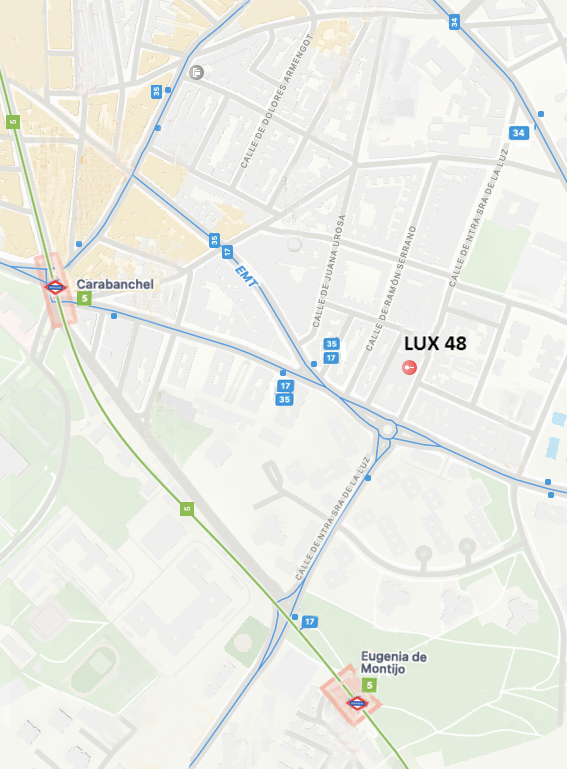
Lux 48 → Calle Nuestra Señora de la Luz, 48, Local 1, Carabanchel
28025 Madrid – Spain
Free admission by appointment
Information, bookings and guided tours:
info@lux48-agn.es
Metro Line 5, station Eugenia de Montijo (6 min);
Bus 17, stop Fátima/Nuestra Señora de la Luz (3 min);
Bus 34, stop Plaza de la Palmera (5 min);
Bus 35, 481, 486, N17, stop Guabairo (4 min)
was born in 1948 in Soest, Germany. He lived in Barcelona from 1988 onwards. He began his artistic trajectory in the mid-1960s. His constant aesthetic and formal experimentation has always been intertwined with conceptual approaches. He has focused his interest on social, cultural and environmental issues, anticipating in his art subjects that only three or four decades later have become widely debated in the public sphere, such as the fragility of the ecosystem, colonialism and human relationships based on sensitivity and affection; therefore, his work is now becoming increasingly current. The hybrid nature of his techniques and materials was a distinctive feature of his cross-disciplinary working method.
His artistic practice was process-oriented, generally structured in cycles or series. Some of the main thematic strands of his body of work were derived from his incisive reflection on the artistic context, the relationships between art and life, human beings and technology, temporality and light, as well as on the mechanisms of memory/forgetting and historical construction/fragmentation. Contemporary archaeology and the poetics of the minuscule were other focal points of extensive cycles.
In Nölle’s own words: “There is another meaning behind my artworks: that sense of dizziness. Life is getting increasingly fast-paced, including from a technical point of view, so that we lose perspective. We look at images and our ability to take them in is reduced to a few seconds. For me, [the artworks] become a metaphor for life as a fleeting moment, a fraction of a second that you cannot control.” (Interview recorded on video, Madrid, 2018)
Nölle has exhibited internationally in solo and group exhibitions at museums, cultural centres, galleries and festivals.
For further information, see Artist Monograph & CV.
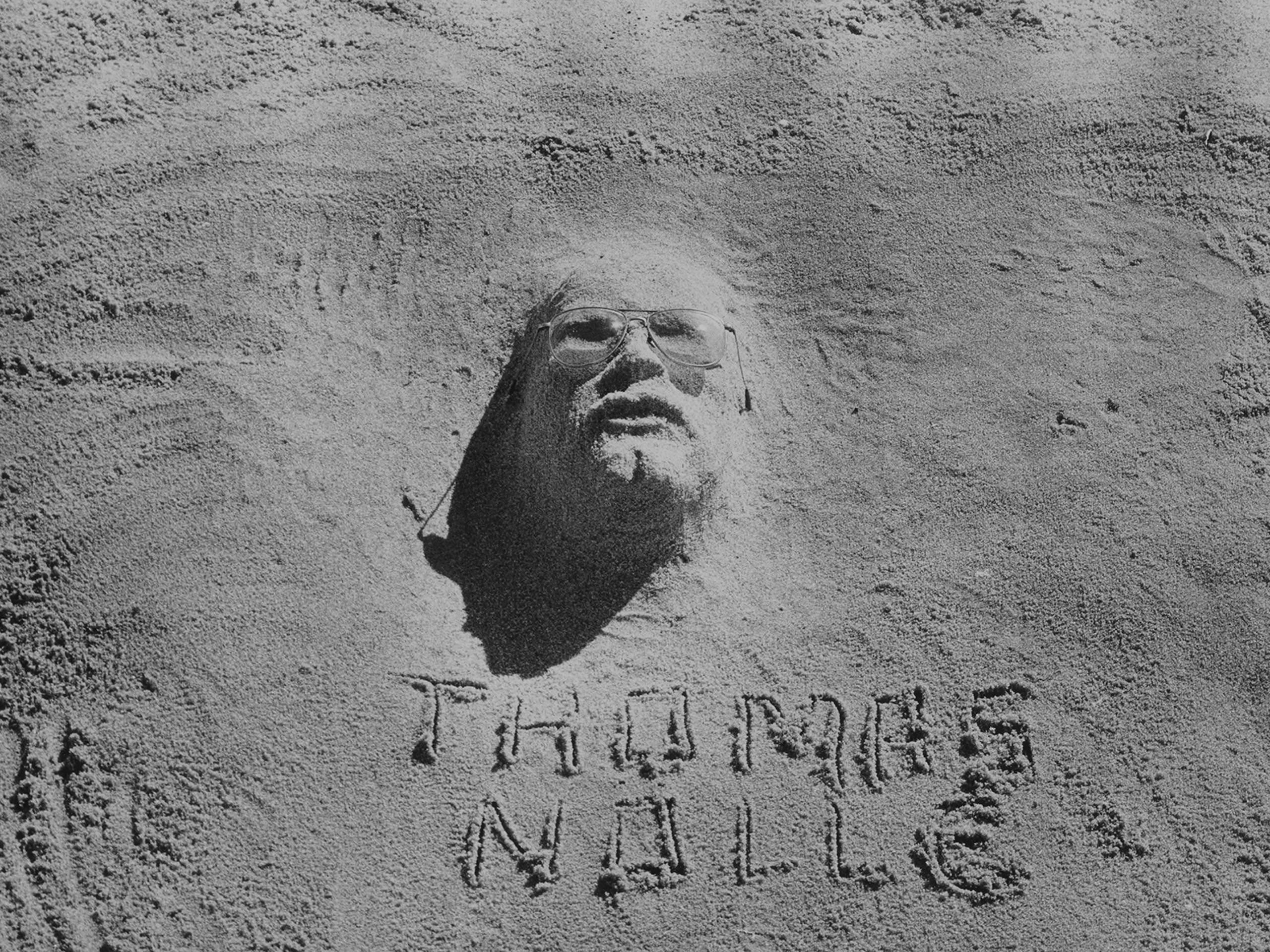
Thomas Nölle, Myself I, 1979. Praia de Macaé (Rio de Janeiro), Brazil © Thomas Nölle
A Brief Selection of Exhibitions
SOLO = Solo exhibition | GR = Group exhibition
-
1977:
Ritterschen Buchhandlung (Merseburger). Soest, DE (SOLO)
-
1977:
Produzenten Galerie, Zurich, CH (SOLO)
-
1978:
Kurhaus Dangast. Dangast, DE (SOLO)
-
1979:
Werkstatt Galerie, Ölcollagen und Objekte. Bonn, DE (SOLO)
-
1983:
Kunsthistorisches Institut Bonn, Klein unter anderem [Klein Amongst Others]. Bonn, DE (SOLO)
-
1984:
Bonner Kunstverein, Nehmen Sie Dada Ernst – Es lohnt sich. Bonn, DE (GR)
-
1984:
Bonner Kunstverein, Das ist doch keine Art [That’s no Way/no Art]. Action by Nölle with JürgenPech during the performance by Jean Tinguely. Bonn, DE
-
1984:
Kunstmuseum Düsseldorf, DE (GR)
-
1984:
Kunst ist Gesundheit – Remember Yves Klein [Art is Health – Remember Yves Klein], Public action by Thomas Nölle with Jürgen Pech in Düsseldorf
-
1985:
Städtisches Museum Mülheim a.d. Ruhr, DE (GR)
-
1987:
Kunsthistorisches Institut, Universität Bonn, Bilder 1986/88. Bonn, DE (SOLO)
-
1987:
Künstlerforum Bonn, DE (GR)
-
1988:
Orangerie Schloss Augustusburg, Room to Move, curator Jürgen Pech, Brühl, DE (SOLO)
-
1990:
Friedrich Naumann Foundation, Mundus Novus I. Königswinter, DE (SOLO)
-
1992:
Städtische Galerie am Herrenteich, Mundus Novus II. Suhl, DE (SOLO)
-
1992:
Institut für Öffentliche Verwaltung NRW, Mundus Novus II. Hilden, DE (SOLO)
-
1993:
L’Angelot, Arte intermedia, Opening exhibition. Barcelona, ES (GR)
-
1993:
L’Angelot, Nölle’s action Arte es salud – Remember Yves Klein, De Viva Veu, No 5. Barcelona, ES
-
1994:
Galería Manoel Macedo, La mer-e. Belo Horizonte, BR (SOLO)
-
1996:
El Purgatori II, Fabled Sea. Valencia, ES (SOLO)
-
1996:
Centro Cultural Brasil-Espanha, Pontes da Memória. Belo Horizonte, BR (SOLO)
-
1998:
Transforma Espacio, Symphonie technique. Vitoria-Gasteiz, ES (SOLO)
-
2000:
Café Schilling, Musée Méditerranée. Barcelona, ES (SOLO)
-
2002:
Museu d’Art de Sabadell, Sin salida de emergencia [Without Emergency Exit]. Sabadell, ES (GR)
-
2002:
Nölle’s Action-performance El criado mudo [The Mute Servant], by opening exhibition Sin salida de emergencia. Museu d’Art de Sabadell, ES
-
2002:
Centro Nacional de las Artes, Sin salida de emergencia [Without emergency exit]. México DF, MX(GR)
-
2002:
MUVIM, Museo Valenciano de la Ilustración y la Modernidad, Observatori III. Valencia, ES (GR)
-
2002:
Arts Centre Gallery, Tiempos dispersos [Dispersed Times]. Barcelona, ES (SOLO)
-
2003:
Museu d’Art Contemporani d’Evissa, Pronóstica. Ibiza, ES (GR)
-
2005:
Arts Centre Gallery, Collector’s Dream. Barcelona, ES (SOLO)
-
2005:
Galería Kumbi Saleh, Danza del Tiempo – Arte de dos Continentes [Dance of Time – The Art from Two Continents]. Barcelona, ES (SOLO)
-
2006:
Centro Cultural de España México, Silencio Vicioso. México DF, MX (SOLO)
-
2006:
V Festival Internacional de Imagen, Entre las imágenes [Between Images]. Manizales, Colombia(SOLO)
-
2006:
Gran Canaria Espacio Digital, XII Canariasmediafest – Festival Internacional de Artes y Culturas Digitales de Gran Canaria, Los Caprichos. Las Palmas de Gran Canarias, ES (GR) (Catalogue)
-
2008:
MEIAC, Museo Extremeño e Iberoamericano de Arte Contemporáneo, El discreto encanto de la tecnología. Artes en España [The Discreet Charm of Technology. Arts in Spain]. Badajoz, ES (GR)
-
2008/
2009:ZKM | Center for Art and Media Karlsruhe. Karlsruhe, DE (GR)
-
2008/2009:
MEIAC, Museo Extremeño e Iberoamericano de Arte Contemporáneo, Tiempos dorados[Golden Times]. Curated by Nilo Casares. Badajoz, ES (SOLO)
-
2009:
Neue Galerie Graz. Graz, AT (GR)
-
2010:
Factoría Santiago, Way of Light. Santiago de Compostela, ES (SOLO) (Catalogue)
-
2014:
Galería Arte Periférica (Centro Cultural de Belém), Musa x paradisiaca. Lisbon, PT (SOLO)
-
2015:
Künstlerhaus Wien, Über: ich [About Me]. Vienna, AT (GR)
-
2015:
CCCB, Centro de Cultura Contemporània de Barcelona, Mare Rostrum. Proyecto, commissioned by Marviva Agencia, Port de Barcelona, with the collaboration of the fishermen of the Mediterranean coast, and Drap-Art. Barcelona, ES (SOLO)
-
2016:
Laie Librería, Musa x paradisiaca. Barcelona, ES (SOLO) (Artist’s book)
-
2016:
SEA≈STORE, actions in public space, Plaza dels Àngels (Drap-Art’16). Barcelona, ES (SOLO)
-
2016:
CCCB, Centro de Cultura Contemporània de Barcelona, Drap-Art’16. Barcelona, ES (GR)
-
2017:
Goethe-Institut de Lisboa, Elsewhere – An Improbable Journey, with Carlos Gasparinho. Lisbon, PT
-
2018:
Museo Nacional del Romanticismo, By the Way. Madrid, ES (SOLO) (Artist’s book edition)
-
2020:
Puxagallery, En Passant. Madrid, ES (SOLO) (Catalogue)
-
2020:
Casa de América, Notas de América del Sur. Un viaje | 1979–1981 [Notes on South America. A Journey | 1979-1981]. Madrid, ES (SOLO) (Artist’s book edition)
-
2025/2006:
Thomas Nölle – My Way – 1956-2019, Opening exhibition of Lux 48. Madrid, ES (SOLO)
Thomas Nölle, My Way, 1956–2019
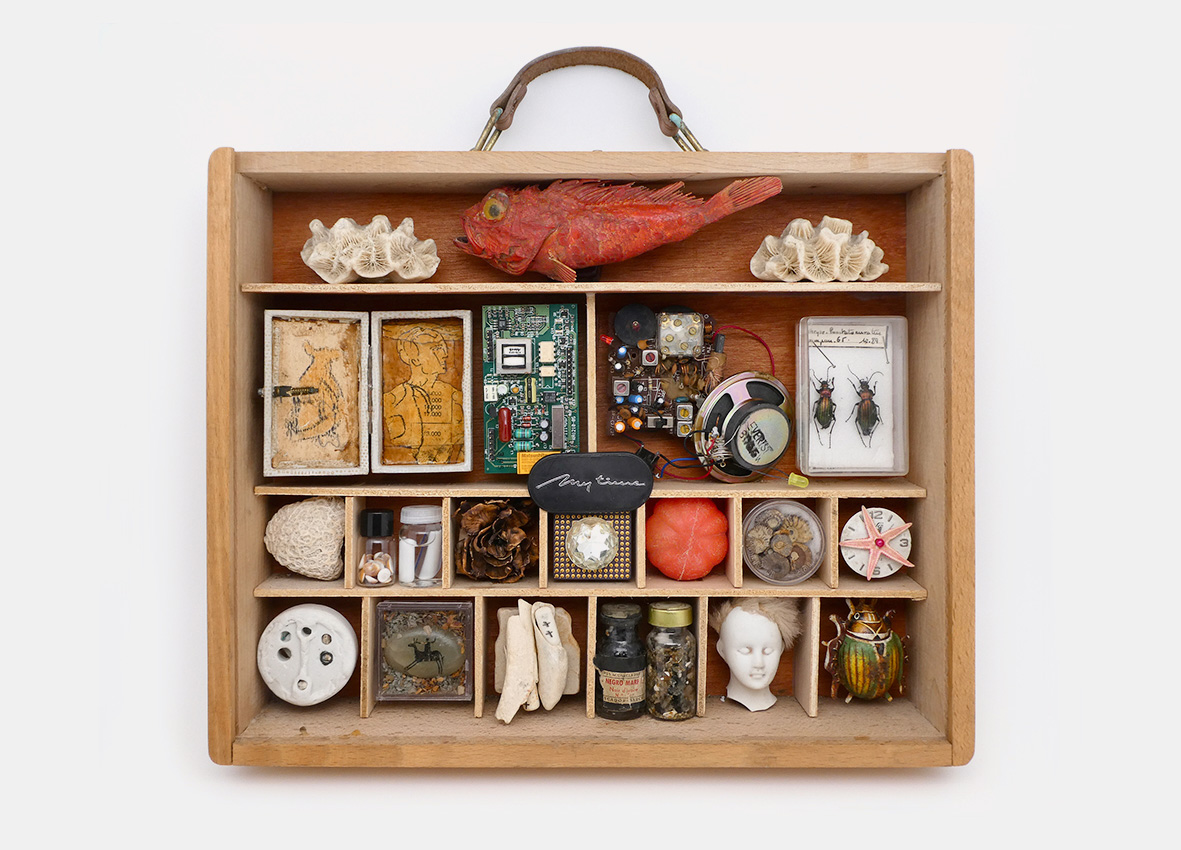
Thomas Nölle, My Time, 2017/2019. Object box, assemblage, 32 x 33 x 6,5 cm. © T. Nölle
My Way brings together artworks created over more than six decades by the artist Thomas Nölle, selected by a curatorial team. This anthological exhibition, whilst not claiming to be exhaustive or chronological, reveals some of the major topics that characterise Nölle’s creative practice, such as nature and environmental issues, social concerns, colonial acculturation, human-machine relationship, and the intertwining of art, life, memory and history. Always imbued with a transgressive, independent and experimental spirit, the aesthetic solutions in his works involve the transdisciplinary use of a wide range of media, materials and techniques.
Curatorial Team: Nekane Aramburu, Norval Baitello Jr., Roberta Bosco & Stefano Caldana, Gustavo Caprín Zara, Martín Carrasco, Nilo Casares, Joan Cruspinera & Annie Pakula, Antoni Esquerra-Torrescasana, Carlos Fadon, Antonio Franco (in memoriam), Carlos Gasparinho, Àngela Montesinos, Maria Pallier, Jürgen Pech, Ulises Pistolo Eliza, Sergio Sabini, Amador Vega
Thomas Nölle was born in Soest (Germany) on 2 December 1948, lived for several years in Bonn and spent some time in Brazil and Portugal; he died in Barcelona—where he had lived and worked since 1988—on 3 June 2020. He developed an interest in art from a very early age. He began taking photographs at the age of 14; he held his first photographic exhibition at 15 and, from then on, artistic creation became the centre of his life.
Based on a process-oriented practice, he channelled his critical awareness of the socio-cultural context and surrounding realities into numerous cycles and series centred on leitmotifs. He embraced and experimented with a variety of media and techniques: photography, painting, drawing, collage, sculpture, assemblage, electrophotography, mixed media, installation, video art, performance for the camera, action and intervention in public spaces.
Curatorial concept
My Way brings together works created over more than six decades, selected by a curatorial team consisting of nineteen members who knew or worked with Nölle at various stages of his career. In tribute to the artist, they generously accepted the invitation to choose a work or a group of works from a series that they considered particularly significant or for which they felt a personal affinity. Each wrote a text or statement offering their own personal view of the selected work.
The selected works address issues that were central to his artistic creation: a) nature and environmental issues, b) social insensitivity, c) colonial acculturation, d) human-machine relationship, e) fragmentation and dynamics of landscapes, f) anatomy of light in photography, and g) the intertwining of art, life, memory and history.
Thematic Relationships
On show, for the first time in Spain, are remarkable artworks from his early period, which reveal the conceptual origins of his later pieces: Das Prinzip Hoffnung [The Principle of Hope] is a photograph from 1965 which the artist considered one of his first artistic works at the age of 15, a search for the transcendent dimension of light in photography. This was revisited from 2008 onwards in the series Cosmic Delight and Way of Light—which paved the way for his experimentation with photographic abstraction—represented in the exhibition by Lichtstrom, Fenster and Celeste respectively.
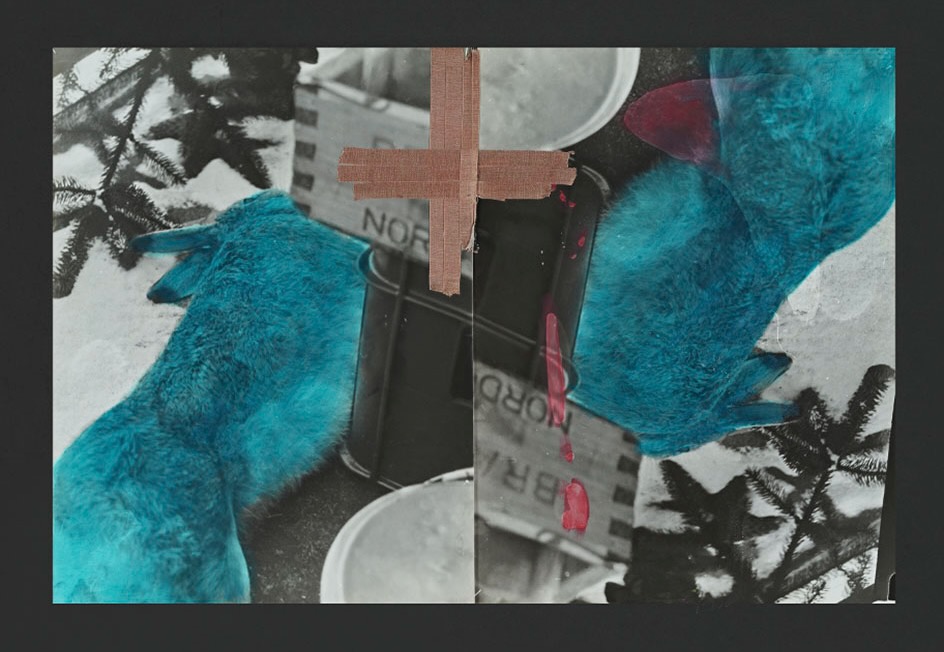
Hand-coloured collaged photographs on b/w gelatine silver prints and medical dressing. © T. Nölle
Toter Hase [Dead Hare] is a 1968 photographic collage with hand-painted black-and-white gelatine silver print—a technique ahead of its time in the context of contemporary art, which he began using in 1966. It is dedicated to the topics running through his entire body of work: nature and ecology. The piece was created at a time when environmental issues were not a subject of public debate.
As a forerunner he also addressed the issue of marine ecology/archaeology in the micro-assemblage works of Fabled Sea (1993–1996), in the sculpture-assemblage Farmacia Mediterránea [Mediterranean Pharmacy] (2000).
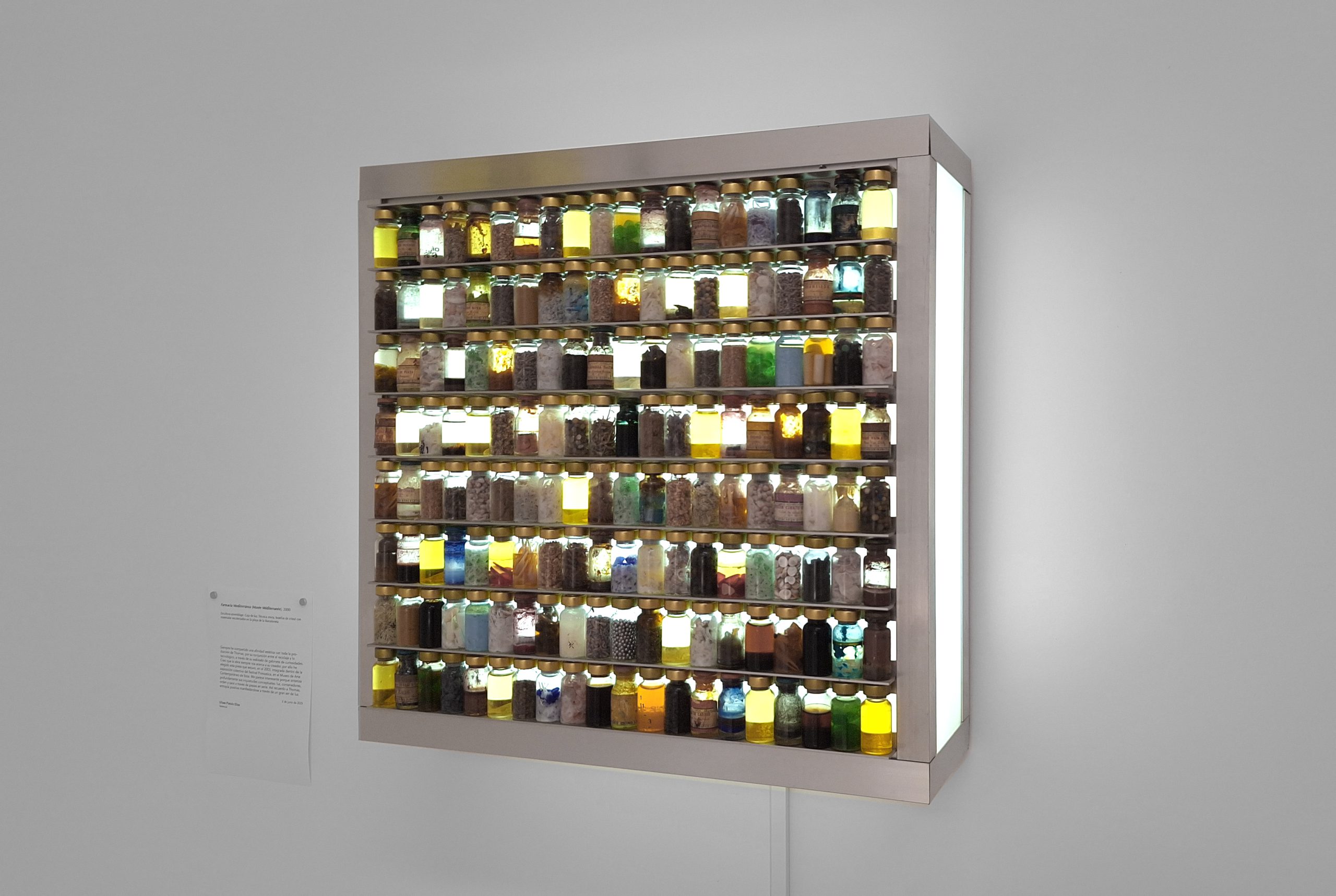
Assemblage sculpture. Light box. Mixed media, glass bottles filled with materials collected on Barceloneta beach. © Lux 48
Skin of Sensibility (1976) is a notable example of performance for the camera—a format that Nölle explored from the 1970s onwards—in which he metaphorically addresses affective anesthesia and the subject’s gradual loss of sensitivity in an increasingly individualistic and impassive society. This artwork forms part of a wider series entitled Blau fließt der Strom der Sensibilität [Blue Flows in the Stream of Sensibility], which includes the photographic sequence Into Nature II (1979), also featured in this exhibition. It is only recently, 45 years later, that the affective turn has made its way onto the social ‘agenda’.
Reflections on human nature, the ephemerality of life and the transitory nature of cultures were evident both in his large-format paintings from the 1980s, created using a palimpsest technique, such as Der Kampf um Eleonore Duse nach Steichen 1903 [The Dispute over Eleonora Duse after Steichen 1903, 1986], as well as in the photo-sequence Into Nature II (1979), the series of photographs By the Way (2010-2013), the video art piece Just a Moment (2010/2015), and in the photographic series Musa (2012), all included in this exhibition.
The conditioning effect of techniques and technologies on life and of the functioning of society is explored in Symphonie Technique (1997), a series in which he revisited the practice of the palimpsest, but using new materials and technical processes.
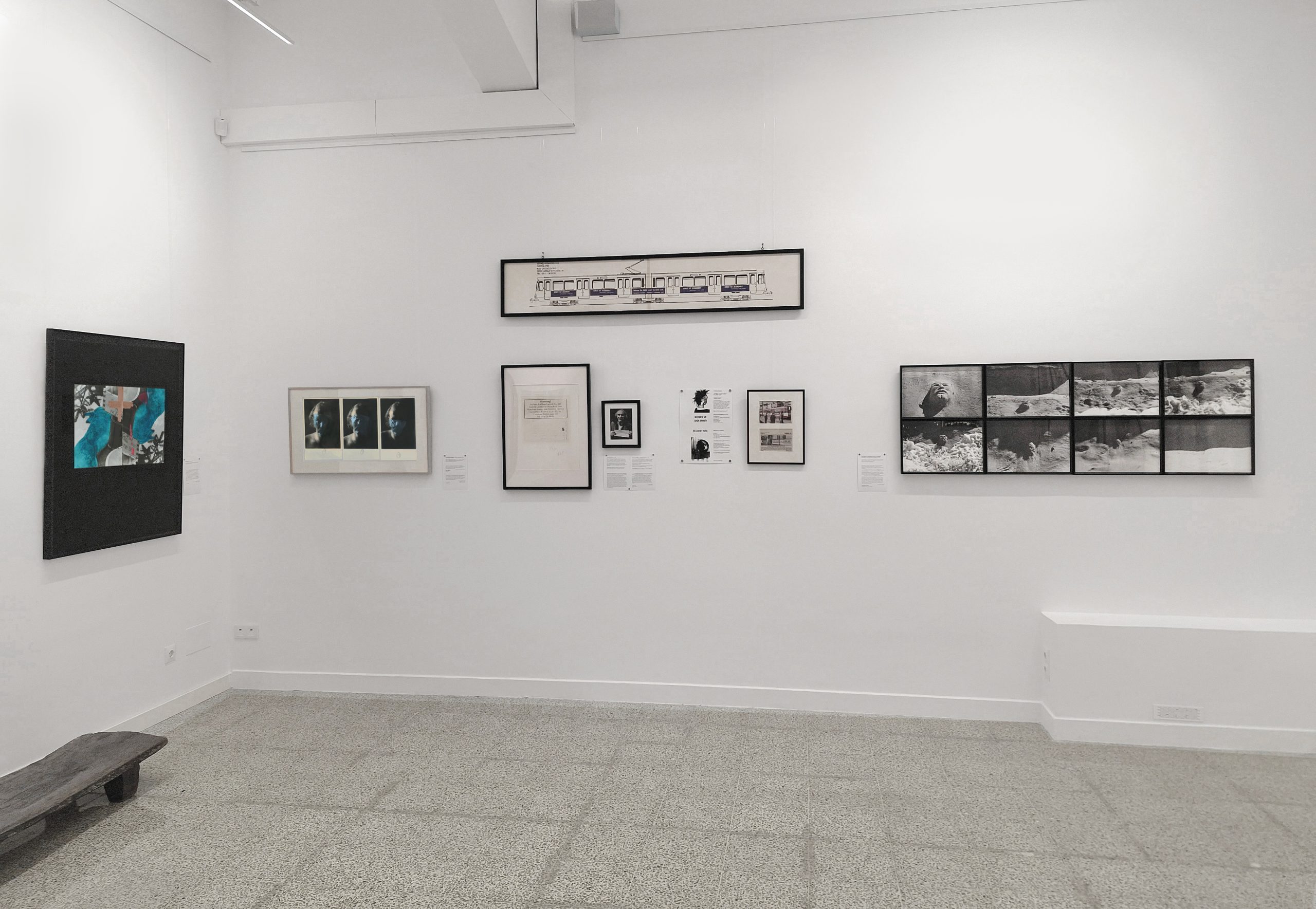
Ironic approaches within the context of art and the relationship between art, life and commercialism were often the subject of works in various formats, such as the performance Das ist doch keine Art [title with a double meaning: “That’s No Way to Behave” or “That’s Not Art”] and the public art intervention Kunst ist Gesundheit – Remember Yves Klein [Art is Health – Remember Yves Klein], both from 1984 in Bonn and Düsseldorf respectively, described by Jürgen Pech, with whom he collaborated.
The installation sculpture In the Garden of Spain (1992) addresses another issue to which Nölle devoted particular attention from 1970 onwards: the effects of (neo)colonialism on native peoples and their territories. The piece thematically dialogues with the collage Brasil (1980), works from the series Um índio em Brasília [A Native in Brasilia] (1980) and from the series Tiempos dorados [Golden Times] (2007–2008).
Catalogue Raisonné
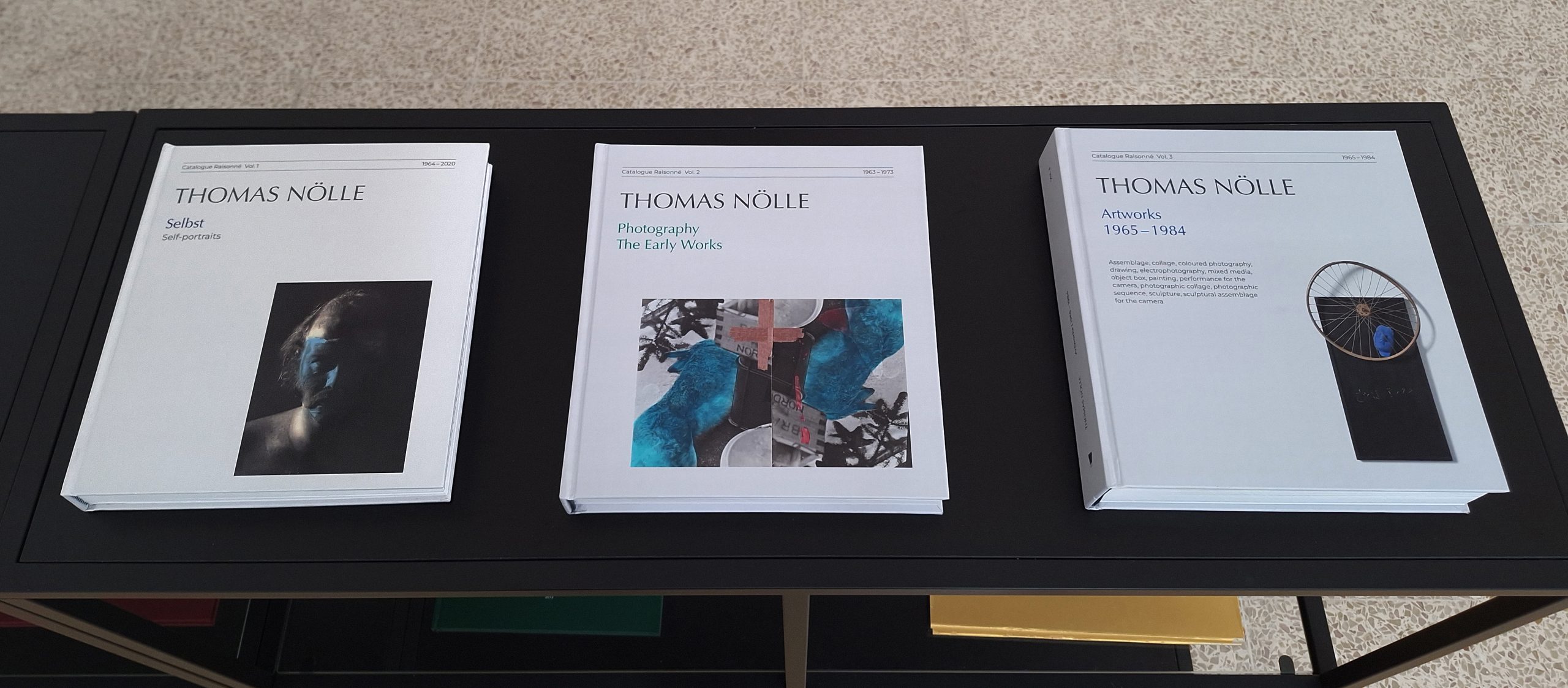
The exhibition is accompanied by the presentation of the first three volumes of his Catalogue Raisonné, which will gradually document his complete body of work: Selbst | Self-portraits 1964-2020 (Volume 1); Photography – The Early Works 1963-1973 (Volume 2); Artworks 1965-1984 (Volume 3).